
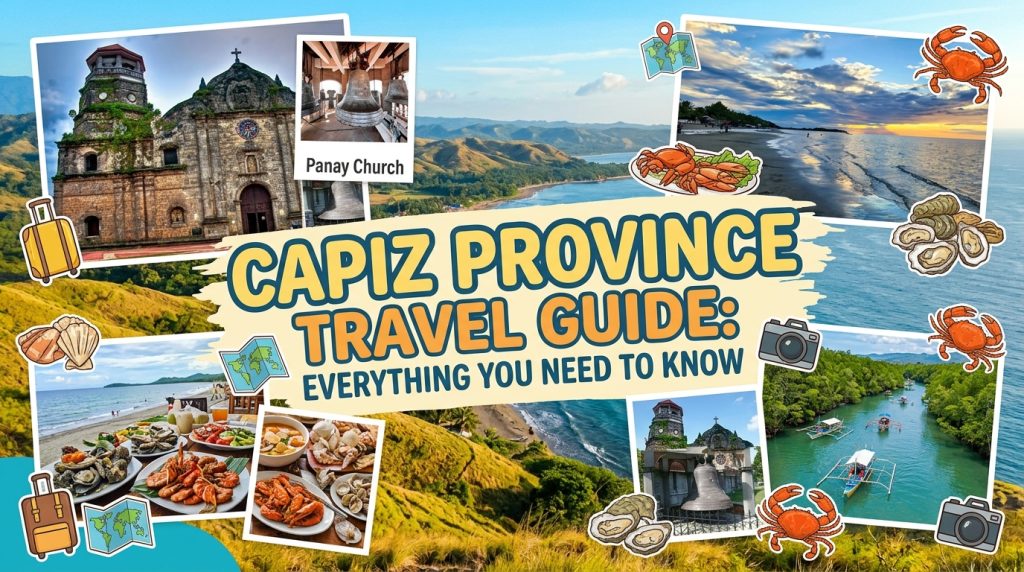
Most travel guides skip Capiz entirely, jumping straight from Iloilo to Boracay as if this province doesn’t exist. That’s the mistake. Capiz sits on the northeastern tip of Panay Island, facing the Sibuyan Sea, and it holds several things most tourists never see: the largest church bell in Asia, some of the least crowded islands in the Visayas, a nationally-awarded cultural festival, and a folklore reputation that’s followed it for generations. This guide covers what’s actually worth your time.
Quick Facts
- Region: Western Visayas (Region VI)
- Capital: Roxas City
- Composition: 1 city (Roxas) and 16 municipalities, split across 473 barangays
- Population: roughly 835,000 (2024 census)
- Land area: about 2,595 square kilometers
- Highest point: Mount Nangtud, 2,074 meters
- Founded: April 15, 1901 (as a civil province — Spanish settlement in the area dates back to 1566)
- Known for: Seafood (“Seafood Capital of the Philippines”), the Capiz shell (Placuna placenta, the translucent shell the province is named after), and its association with aswang and manananggal folklore
Where Is Capiz and How Do You Get There
Capiz borders Aklan to the north, Antique to the west, and Iloilo to the south, and faces the Sibuyan Sea. Roxas City is the capital and your entry point for almost everyone visiting.
By air: Roxas City has its own airport (Roxas Airport, IATA code RXS), with regular flights from Manila. Check current schedules and flight duration before booking, since routes and frequency change.
Travel between Manila (MNL) and Roxas City (RXS) is convenient, with approximately 14 to 19 direct flights each week. That works out to an average of about two direct flights per day, with services available in both directions.
Travel between Manila (MNL) and Roxas City (RXS) is served by two airlines: Cebu Pacific and Philippine Airlines (PAL). Both offer direct flights, with schedules and the number of weekly flights varying depending on the travel period. The flight typically takes around 1 hour and 5 minutes to 1 hour and 15 minutes.
By land/sea from other parts of Panay or Iloilo: If you’re already in Iloilo City, buses and vans run regularly to Roxas City. Travelers coming through Kalibo (Aklan) can also transfer by bus or van.
Roxas City is also accessible by passenger ferry. 2GO Travel operates a direct route from Batangas Port to Roxas City, with the voyage taking approximately 17 to 18 hours. The ships arrive at Culasi Port in Roxas City, making this an alternative for travellers who prefer sea travel or want to bring more luggage or a vehicle.
Travellers coming from Caticlan and Boracay can also take a 2GO ferry to Roxas City. The Caticlan–Roxas journey takes about 5 hours, with several sailings each week.
Because ferry schedules can change due to weather, vessel schedules and operational adjustments, check the latest 2GO schedule before travelling.
We’ll cover exact fares, schedules, and a full cost breakdown in a separate Practical Guide article — this section is just the overview.
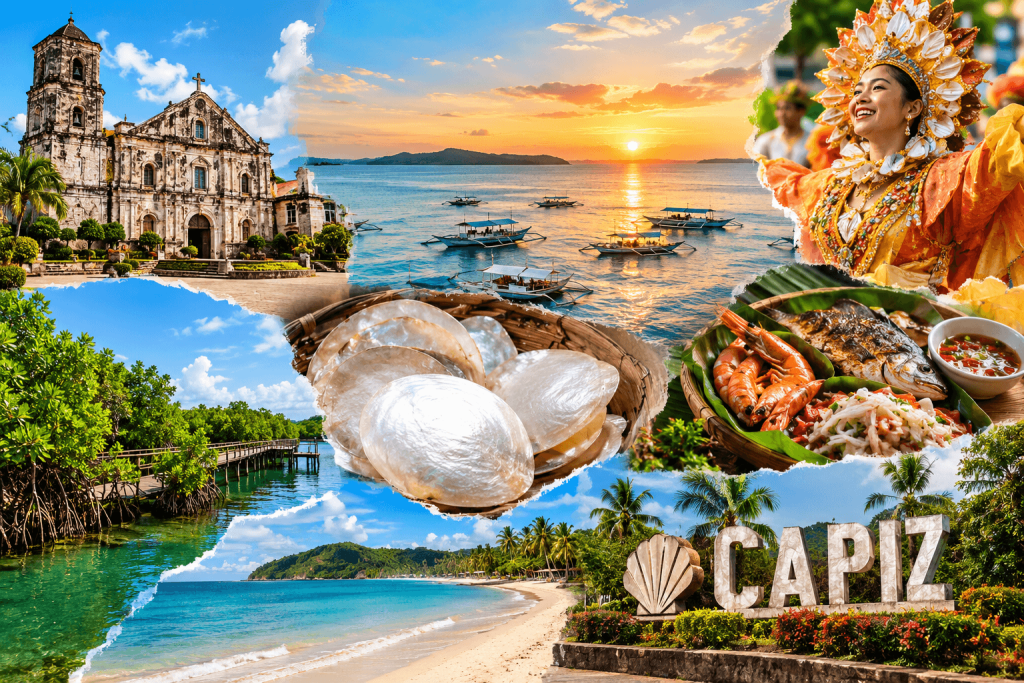
Top Things to See in Capiz
Sta. Monica Church and the Dakong Lingganay (Panay Town)
About 8 kilometers from Roxas City, the town of Panay is home to Sta. Monica Church and its bell, the Dakong Lingganay (“big bell”) — recognized as the largest Catholic church bell in Asia. Cast in 1878 by Juan Reina from 70 sacks of gold and silver coins donated by the townspeople, the bell weighs roughly 10.4 metric tons, stands 5 feet tall, and measures 7 feet in diameter. It hangs in a five-story belfry alongside eight smaller bells. The church itself, built from coral stone and completed in 1884, has been declared a National Historical Landmark. Visiting the belfry requires permission from the parish office, so plan to stop there first before climbing up. Once inside the church, look for the three-meter-thick coral walls and the carved retablos in the side chapels — the bell tends to overshadow the rest of the church, but it’s worth the slower look.
The Manuel Roxas Ancestral House (National Historical Shrine)
The preserved childhood home of Manuel A. Roxas, the first president of the Philippine Third Republic and Capiz’s most famous son. It’s a National Historical Shrine, and Roxas City itself was renamed in his honor.
Baybay Beach, Roxas City
The most accessible beach in the province, a short ride from the city center. It’s not a postcard tropical paradise — think local beach town, not Boracay — but it’s the spot for sunset views, beachfront seafood restaurants, and a relaxed afternoon without a plane ticket to some far island. Locals also point to Ivisan, Pan-ay, and Pilar as having their own stretches of beach if you want variety beyond Baybay.
Olotayan Island
A small island barangay of Roxas City (population just over 1,000), sitting off the coast and known for clearer water and a quieter shoreline than Baybay. Boats leave from Banica Pier in Roxas City, and the crossing takes roughly 45 minutes to an hour by motorized outrigger. Entrance to the island itself is typically free; boat rental and cottage fees are negotiated with the boatman and vary by group size, so confirm current rates before you go — these change over time and by season. There are no fancy hotels here, just a few basic cottages for those staying overnight; most visitors go as a day trip. According to local lore, the island itself is said to have formed when a mythical anito struck an evil giant with lightning, scattering pieces of the giant’s body across the sea — Olotayan being one of them.
Pilar Cave and Agtalin Shrine (Pilar)
The municipality of Pilar is known for caves and rivers, and it’s also home to Pilar Bay, said to be the longest bay in the province and a major fishing ground. Pilar Cave sits along the highway and is one of the province’s more unique rock formations to explore. Nearby, the Agtalin Shrine — a large statue of the Blessed Mother — sits atop Agtalin Hill in Barangay Dulangan, visible from the highway and built above Agtalin Chapel.
Palina Greenbelt Ecotour
A mangrove and river ecotour built around efforts to rehabilitate the once heavily-silted Palina River. It’s a low-key way to see a different side of Capiz’s coastline and understand the conservation work happening around the province’s fishing waters.
Roxas City Itself
Beyond the beach, Roxas City has the Roxas City Museum, the Immaculate Conception Metropolitan Cathedral, and Capiz Provincial Park, along with the general waterfront area worth a wander if you have downtime between other trips.
The Aswang and Folklore Angle
You can’t write about Capiz honestly without addressing this: the province carries a long-standing reputation as the folklore capital of the Philippines, tied to aswang and manananggal legends. If that’s part of why you’re curious about Capiz, don’t skip our Folklore & Aswang Lore section — we cover the real history and talk to locals about where these stories actually come from. (For what it’s worth, locals themselves tend to have a good sense of humor about the reputation.)
When to Visit
Capiztahan is the province’s biggest annual event and the one to plan around if you can. Held every April 13–15, it’s Capiz’s longest-running festival, marking the founding anniversary of the province’s civil government (established April 15, 1901) while doubling as a memorial for former president Manuel A. Roxas. It recently won Grand Winner for Best Cultural Festival (Provincial Category) at the national Pearl Awards, jointly given by the Association of Tourism Officers of the Philippines and the Department of Tourism. Expect a triathlon competition, a Giants Parade featuring giant mythical and seafood-themed figures, street dancing, cultural performances from all 16 municipalities and Roxas City, trade fairs, and a lively night market — the province is a completely different place during Capiztahan week. We’ve dedicated a full article to it, since it deserves more than a paragraph here.
Sinadya sa Halaran, a separate harvest-themed festival, also takes place in the province but runs on a smaller scale than Capiztahan.
Outside festival season, Capiz doesn’t have a strict “bad time to visit” — like most of the Philippines, expect rainy season roughly June through November and drier conditions December through May.
What Capiz Is Known For (Beyond the Obvious)
- Seafood — Roxas City carries the title “Seafood Capital of the Philippines.” Our Food & Seafood section covers exactly what to eat and where.
- Capiz shell — the translucent windowpane oyster shell (Placuna placenta) that gave the province its name, historically used for windows and still used today in décor, lampshades, and trays.
- Folklore — covered above, and covered in depth elsewhere on this site.
Sample First-Timer Itinerary
Day 1: Arrive Roxas City, settle in, Baybay Beach for sunset, seafood dinner. Day 2: Morning trip to Panay town for Sta. Monica Church and the bell, afternoon at the Manuel Roxas Ancestral House and around Roxas City itself. Day 3: Boat trip to Olotayan Island from Banica Pier (weather permitting), or a deeper dive into Pilar’s cave and shrine if you’d rather stay land-based.
We’ll expand this into a full day-by-day breakdown with costs in a dedicated itinerary article.
Frequently Asked Questions
Capiz is known as the “Seafood Capital of the Philippines,” home to the largest Catholic church bell in Asia in Panay town, and a long-standing association with aswang and manananggal folklore. The province also produces the translucent Capiz shell, historically used in traditional Philippine windows and still used today in décor.
Yes, especially if you want an alternative to more crowded Panay Island destinations like Boracay. Capiz offers heritage sites like Sta. Monica Church, quieter islands such as Olotayan, strong seafood, and a nationally-recognized cultural festival in Capiztahan — without the tourist volume of nearby hotspots.
The most direct route is flying into Roxas Airport (RXS) in Roxas City. Travelers can also fly or take a ferry into Iloilo or Kalibo and transfer by bus or van to Roxas City.
The Dakong Lingganay, housed in the belfry of Sta. Monica Church in Panay, Capiz, is recognized as the largest Catholic church bell in Asia. Cast in 1878 from donated gold and silver coins, it weighs roughly 10.4 metric tons.
Capiz is the province most associated with aswang and manananggal folklore in Filipino pop culture, largely due to decades of movies, TV, and word-of-mouth reputation. Locals generally treat the association with humor rather than as a literal warning.
Capiztahan is Capiz’s longest-running and biggest annual festival, held every April 13–15. It marks the founding anniversary of the province’s civil government and honors former president Manuel A. Roxas, featuring a triathlon, a Giants Parade, street dancing, and a province-wide night market.
Capiz is generally considered a safe destination for travelers, similar to most provincial areas in the Philippines. Standard travel precautions apply — confirm current conditions and any local advisories before your trip.
Where This Guide Goes From Here
This page will keep growing as we publish deeper guides on each topic above. Bookmark it, or check the Travel & Islands category page for the full list of what’s live.
Related reading: Capiz Food Guide: What to Eat in the Seafood Capital | How to Get to Capiz from Manila | Capiztahan Festival Guide | The Aswang of Capiz