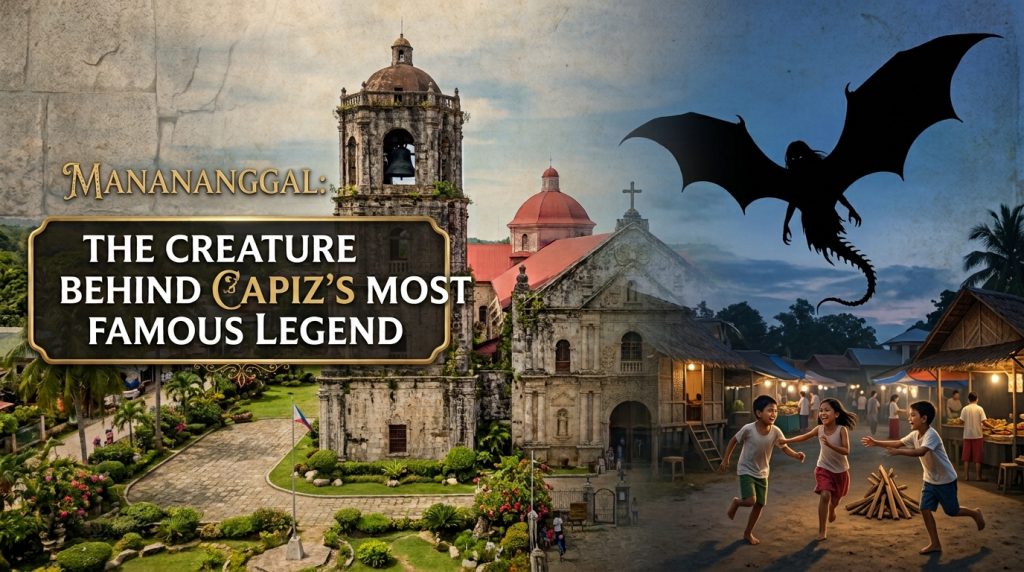
If one image defines Capiz’s folklore reputation more than any other, it’s this: a woman’s torso, split at the waist, sprouting bat-like wings, flying alone through the dark in search of prey. That’s the manananggal — and while it belongs to the broader aswang family we’ve already covered, it deserves its own deep dive, because it’s specific enough, old enough, and detailed enough in the folklore record to stand on its own.
Quick Facts
- Name origin: from the Tagalog word tanggal, meaning “to remove” or “to separate” — manananggal roughly translates to “self-segmenter” or “one who separates itself”
- Classification: a specific type of aswang, the broader umbrella term for Filipino shape-shifting, flesh-eating folklore creatures
- Typical depiction: usually female, capable of severing its upper torso from its lower half and growing large bat-like wings to fly at night
- Earliest documented reference: appears in Customs of the Tagalogs, written by Spanish Franciscan friar Juan de Plasencia in 1589 — meaning belief in this creature (or something very close to it) was already recorded within decades of Spanish colonization
How the Legend Describes It
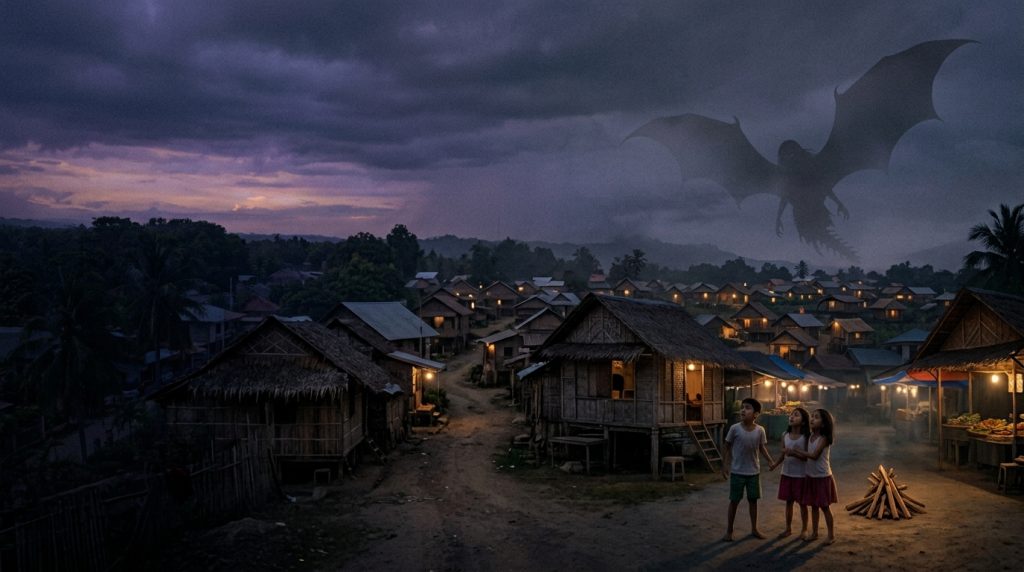
According to the folklore, a manananggal prepares for the hunt by covering its body in oil — said to be the source of its power — before splitting its torso at the waist. The lower half is left standing upright somewhere hidden, while the winged upper half flies off to feed. Using an elongated, proboscis-like tongue, it’s said to target sleeping victims, most commonly pregnant women, piercing through rooftops to reach its prey and feeding on blood or, in the most feared version of the story, the hearts of unborn fetuses.
Beyond pregnant women, some tellings extend its targets to newlyweds, grooms, and newborn children — with certain versions framing the manananggal as a figure driven by jealousy or a tragic, vengeful origin story, a recurring theme in female-monster folklore found in other cultures too (comparisons to La Llorona in Latin American folklore come up in some academic folklore collections for exactly this reason).
Weaknesses, According to Folklore
Like most aswang variants, the manananggal is said to be repelled or harmed by:
- Garlic
- Salt
- Holy water
- Vinegar and certain spices
- Sunlight — often described as fatal to the creature while in its monstrous form
- The tail of a stingray, historically used as a whip-like ward against it in some tellings
The most consistent piece of practical folklore across sources: to destroy a manananggal, you’re supposed to find its abandoned lower torso before it returns at dawn, then apply salt, ash, or crushed garlic to the exposed flesh — preventing the two halves from rejoining. If the halves can’t reunite before sunrise, the creature is said to die.
Is the Manananggal Only a Capiz Creature?
Not exclusively — the broader myth is recognized across the Philippines, and belief in similar creatures shows up outside Capiz too. But Capiz is consistently and specifically cited across folklore references as a focal point for manananggal lore in particular, more so than for aswang stories generally. That’s part of why this creature, more than any other single aswang variant, has become so tightly linked to the province’s identity.
The Manananggal vs. the Wakwak (A Common Mix-Up)
If you dig into Philippine folklore further, you’ll run into the Wakwak — another vampiric, bird-like creature that hunts at night in similar ways. The key difference: the Wakwak cannot separate its torso from its body the way a manananggal can, and it’s associated with a distinctive flapping sound while hunting, said to grow fainter the closer it gets to its target. If a story mentions the ability to split into two halves, that’s specifically manananggal lore, not Wakwak.
From Folklore to Pop Culture
The manananggal has had a long life in Philippine media well beyond oral storytelling — it’s been the subject of Philippine films dating back to at least 1927, and has continued showing up in comics, television, and video games as one of the most recognizable creatures in Filipino horror media. Some tourism initiatives have even leaned into the legend directly, building festivals and themed attractions around it rather than treating it purely as something to fear — a pattern consistent with the more playful, complicated relationship Capiznons themselves often have with the reputation, covered in more depth in our main Aswang article.
Frequently Asked Questions
Manananggal comes from the Tagalog word tanggal, meaning “to remove” or “to separate,” describing the creature’s defining trait of splitting its torso from its lower body.
Not exactly — aswang is a broad umbrella term covering many types of Filipino folklore creatures, including witches, ghouls, and shape-shifters. The manananggal is one specific type within that broader category.
Folklore commonly cites garlic, salt, holy water, vinegar, spices, sunlight, and the tail of a stingray as ways to repel or destroy a manananggal, along with applying salt or garlic to its abandoned lower torso before dawn.
The broader myth is recognized across the Philippines, but Capiz is consistently cited in folklore references as a particular focal point for manananggal stories specifically, more so than for other regions.
Related reading: The Aswang of Capiz: Why This Province Is Ground Zero for Philippine Folklore
As a versatile digital strategist, the author brings a wealth of technical and creative expertise to the table. He is a “Certified Content Marketing Specialist” with several years of experience navigating the complexities of “digital marketing” and “SEO” to drive meaningful engagement. Beyond the screen of analytics, he is deeply passionate about the intersection of form and function, maintaining an active practice in both **web design** and **web development** to build seamless, high-performing digital experiences.