
Last updated: 2026. Festival dates and diwal harvest openings change from year to year, so confirm specifics before you book.
The short answer: April is the best single month to visit Capiz. It’s the driest month of the year, and it’s when Capiztahan, the province’s biggest festival, takes over the province of Capiz. The catch is that April is also hot and busy, so book early. If you’d rather trade the festival for quieter streets, February and March offer similar dry weather with fewer crowds. This guide breaks down the whole year, month by month, including the typhoon months and the seafood calendar.
The Short Answer
| If you want | Go in | Why |
|---|---|---|
| The most comfortable weather | February to April | Rated the most comfortable months by climate normals, with relatively low rain |
| Festivals | Mid-April or early December | Capiztahan and Sinadya sa Halaran |
| Diwal and the seafood harvest | July to September, when harvests are open | Roxas City’s diwal grounds traditionally open in this window |
| Fewer crowds | January to March, outside festival weeks | No major province-wide events |
| Lower typhoon odds | February to September | Direct hits on Capiz have clustered in the November to January window |
How Capiz’s Weather Actually Works
Most of the year, Capiz is an easy place to travel. The real planning variable is a major typhoon, which is the same risk you’d face anywhere in the Visayas. Beyond that, it’s mostly a question of how much rain and heat you want to deal with.
Temperature. It hardly moves. Roxas City averages about 27.7°C across the year, with monthly averages staying within a narrow range of roughly 25°C to 28°C. May is the hottest month and January the coolest, and the difference is small. Annual rainfall averages around 2,200 millimeters.
Rain. PAGASA classifies the climate of Capiz’s towns as Type III, which means the seasons are not sharply defined. PhilRice’s soils database, citing that classification, describes rainfall as relatively lower from about November to April and heavier during the rest of the year, with April the driest month and June the wettest. Treat that as a general guide, not a promise. November to January is also the Amihan (northeast monsoon) season, and PAGASA’s weekly outlooks have at times flagged northern Western Visayas for high chances of heavy rain in December. Some weather datasets even show a December rainfall peak for Roxas City. Pack a rain jacket in any month.
Typhoons. Nationally, the typhoon season is counted from about June to November, and in July to September most storm tracks stay in Luzon. Capiz’s risk follows a different calendar. PAGASA says tracks in November and December usually run along the Visayas and northern Mindanao, and a PAGASA Mactan official has explained that the Amihan winds pull late-season cyclones southward. PAGASA’s climatology still lists a track across the central Philippines in January, though fewer storms form that month. That matches what Capiznons already know from experience: direct hits on the province have tended to come between November and January.
Three storms show the pattern. Typhoon Undang (Agnes) crossed the Visayas in early November 1984. PAGASA lists 895 deaths nationwide, other counts run above 1,000, and one summary of the storm reports 265 deaths in Capiz alone. Its memory lasted: when Yolanda approached in 2013, a family evacuating in Pilar told an International Organization for Migration team that the memory of Undang was uppermost in their minds.
Super Typhoon Yolanda (Haiyan) crossed northern Panay in November 2013, with PAGASA recording gusts of 205 kilometers per hour at Roxas City, and Capiz was the hardest-hit province on Panay. Six years later, Typhoon Ursula (Phanfone) passed close to Roxas City on Christmas morning 2019, flooding the town center of President Roxas to chest height and damaging or destroying more than 55,000 houses across Panay.
You also don’t need a direct hit to get flooded. In October 2025, Tropical Storm Ramil (Fengshen) made landfall in Sorsogon, far to the east, yet it dropped nearly 400 millimeters of rain on Roxas City in a single day. City officials said it was the first time almost every barangay in the city had flooded, and the city council declared a state of calamity.
Don’t rely on the calendar alone. Researchers have linked climate change to the intensification of recent Philippine typhoons and suggest future ones may be stronger, so treat any seasonal pattern as odds. Check PAGASA’s forecasts in the days before you travel, and again the morning you leave.
Month by Month
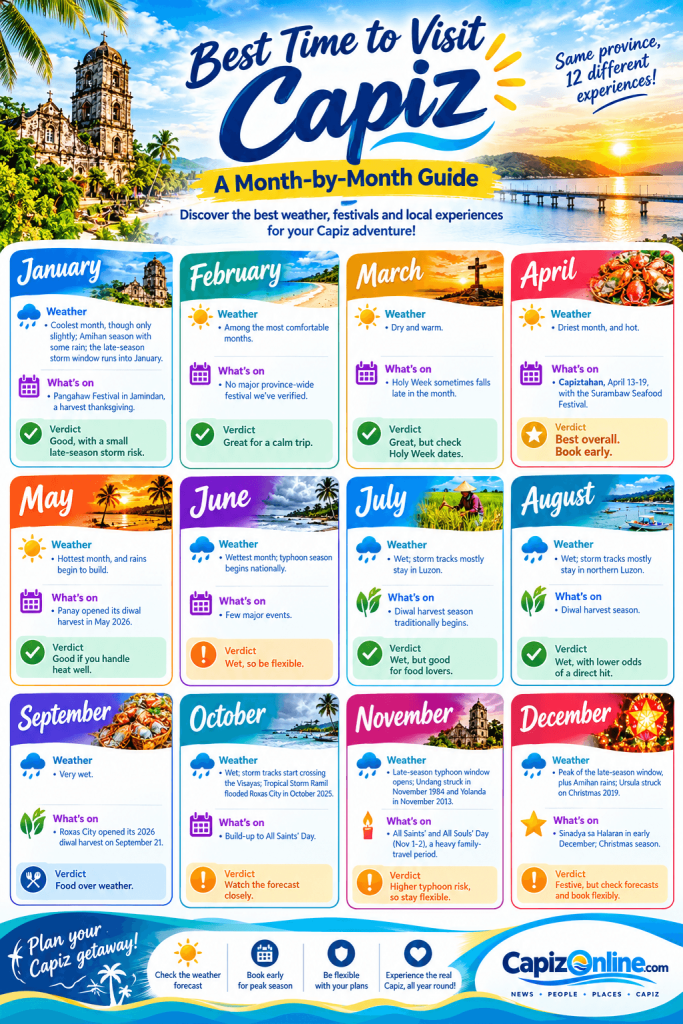
| Month | Weather | What’s on | Verdict |
|---|---|---|---|
| January | Coolest month, though only slightly; Amihan season with some rain; the late-season storm window runs into January | Pangahaw Festival in Jamindan, a harvest thanksgiving | Good, with a small late-season storm risk |
| February | Among the most comfortable months | No major province-wide festival we’ve verified | Great for a calm trip |
| March | Dry and warm | Holy Week sometimes falls late in the month | Great, but check Holy Week dates |
| April | Driest month, and hot | Capiztahan, April 13-19, with the Surambaw Seafood Festival | Best overall. Book early |
| May | Hottest month, and rains begin to build | Panay opened its diwal harvest in May 2026 | Good if you handle heat well |
| June | Wettest month; typhoon season begins nationally | Few major events | Wet, so be flexible |
| July | Wet; storm tracks mostly stay in Luzon | Diwal harvest season traditionally begins | Wet, but good for food lovers |
| August | Wet; storm tracks mostly stay in northern Luzon | Diwal harvest season | Wet, with lower odds of a direct hit |
| September | Very wet | Roxas City opened its 2026 diwal harvest on September 21 | Food over weather |
| October | Wet; storm tracks start crossing the Visayas; Tropical Storm Ramil flooded Roxas City in October 2025 | Build-up to All Saints’ Day | Watch the forecast closely |
| November | Late-season typhoon window opens; Undang struck in November 1984 and Yolanda in November 2013 | All Saints’ and All Souls’ Day (Nov 1-2), a heavy family-travel period | Higher typhoon risk, so stay flexible |
| December | Peak of the late-season window, plus Amihan rains; Ursula struck on Christmas 2019 | Sinadya sa Halaran in early December; Christmas season | Festive, but check forecasts and book flexibly |
The Festival Calendar
Pangahaw Festival (January, Jamindan). A harvest thanksgiving. The name comes from “mahaw,” meaning breakfast, tied to the thanksgiving rituals held before the community ate the new harvest.
Capiztahan (April 13-19). The province’s biggest and longest-running festival, marking the founding of Capiz’s civil government on April 15, 1901, and honoring Manuel A. Roxas. See our Capiztahan guide for the full program and history.
Sinadya sa Halaran (early December). Roxas City’s own festival for the Feast of the Immaculate Conception, with religious observance, street dancing, concerts, and a food and seafood festival. It carries the name of Halaran, an old thanksgiving tradition. Our Roxas City guide covers it in detail.
Other towns hold their own fiestas throughout the year, so if you want to catch one, check the municipality’s schedule before you travel.
The Seafood Calendar
Most of Capiz’s seafood, including oysters, crab, and scallops, is generally available year-round. Diwal is the exception.Local knowledge puts diwal spawning at roughly January to July and the harvest from about July to September, and each municipality decides when to open its own grounds. In 2026, Panay began harvesting and selling diwal in May, and Roxas City officially opened its harvest on September 21. Dates vary by year and by area, so don’t build a trip around a guaranteed diwal date. Our Diwal guide explains how the openings work.
Crowds and Booking
Expect full hotels and busy roads around these periods:
- Capiztahan week in mid-April
- Sinadya week in early December
- Holy Week, whose dates change every year
- Christmas to New Year
- All Saints’ Day and All Souls’ Day (November 1-2)
Outside those windows, Roxas City is calm. Weekdays are quieter than weekends nearly everywhere.
Best Time for Specific Plans
- Beach days and island trips (Baybay Beach, Olotayan): the drier months, roughly February to April, offer the best odds. Boat trips depend on sea conditions at any time of year, so confirm with your boatman or accommodation the day before.
- Heritage and churches (Sta. Monica Church, the Roxas City heritage core): any dry day works. Go early to avoid the midday heat.
- Food trips: July to September if you want a chance at diwal, any month for the rest of Capiz’s seafood.
- Festivals: mid-April or early December.
Planning Tips
- Book flexible rates for any trip between November and January, and expect heavy rain at times from June to October.
- Check PAGASA advisories a few days before departure and again the morning you leave.
- Pack light layers and a rain jacket, whatever the month.
- Start sightseeing early. The heat peaks around midday, especially April and May.
- Don’t plan tight ferry or flight connections around storm advisories, since sailings and flights can be canceled with little notice.
Frequently Asked Questions
April is the best single month: it’s the driest month and the month of Capiztahan, the province’s biggest festival. February and March are strong alternatives with fewer crowds.
Nationally, the typhoon season runs roughly from June to November, but Capiz’s main risk window is November to January, when the Amihan winds steer storms across the Visayas. Typhoon Undang struck in November 1984, Super Typhoon Yolanda in November 2013, and Typhoon Ursula in December 2019. Storms can still occur at other times, so check PAGASA advisories for any trip.
Rain can fall in any month. PhilRice’s database, citing PAGASA’s Type III classification, describes April as the driest month and June as the wettest, with heavier rain from about May to October. November to January also brings Amihan rains to northern Panay, so December can be wet. Flooding can also come from storms that miss the province: in October 2025, Tropical Storm Ramil dropped nearly 400 millimeters on Roxas City in one day.
Diwal harvest typically runs from about July to September, but each municipality sets its own opening. In 2026, Panay opened its harvest in May and Roxas City opened on September 21.
Capiztahan runs in mid-April, generally April 13 to 19, with the founding anniversary on April 15.
It’s festive, with Sinadya sa Halaran in early December and the Christmas season, but it’s also inside the late-season typhoon window and can be rainy. Typhoon Ursula struck on Christmas Day 2019. Book flexible rates and check forecasts before you go.
It says usually yes, the main exception is a major typhoon, the same risk as anywhere in the Philippines, and to check PAGASA forecasts and book flexibly. That’s your point. If you’ve pasted the FAQ into your FAQ block, add this seventh question there.
Related reading: Capiz Province, Philippines: Complete Travel Guide | Capiztahan Festival: Dates, History, and What to Expect | Diwal: Capiz’s Rarest Delicacy, Explained | How to Get to Capiz from Manila

As a versatile digital strategist, the author brings a wealth of technical and creative expertise to the table. He is a “Certified Content Marketing Specialist” with several years of experience navigating the complexities of “digital marketing” and “SEO” to drive meaningful engagement. Beyond the screen of analytics, he is deeply passionate about the intersection of form and function, maintaining an active practice in both **web design** and **web development** to build seamless, high-performing digital experiences.