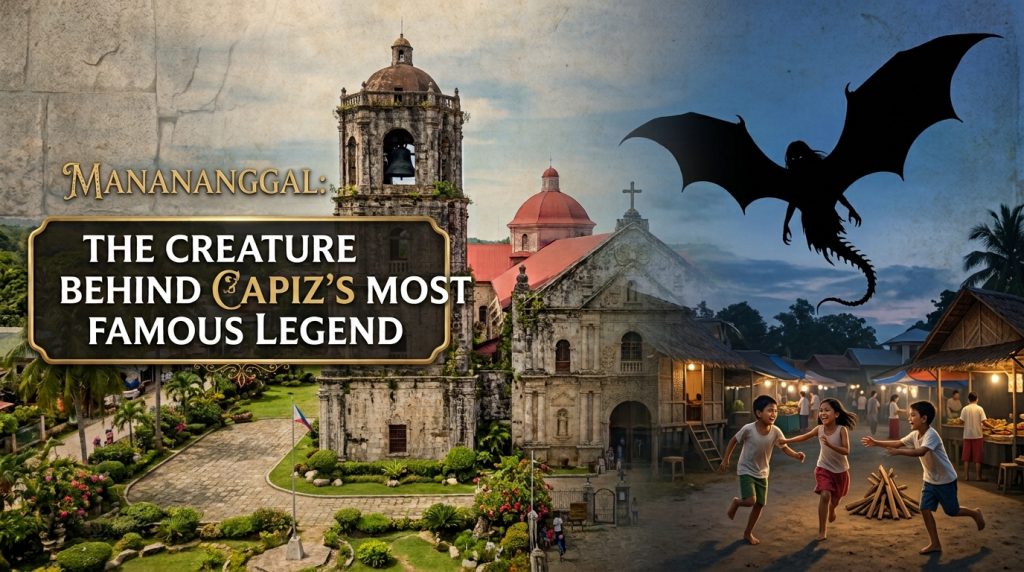
Say you’re from Capiz anywhere else in the Philippines, and there’s a decent chance someone jokes that you “flew in.” That’s how deep the aswang association runs — deep enough that some Capiznons working in Manila reportedly avoid mentioning where they’re from just to skip the joke. This is the real history behind that reputation, not the recycled ghost-story version.
Quick Facts
- Aswang is an umbrella term in Filipino folklore covering shape-shifting, flesh-eating creatures — witches, ghouls, viscera-suckers, and werebeasts all fall under it
- Manananggal is a specific type of aswang: a creature that splits its body at the torso, grows bat-like wings, and flies off to feed, classically targeting pregnant women using an elongated proboscis-like tongue
- Aswang belief is strong across Western Visayas broadly — Capiz, Iloilo, Negros, Bohol, Masbate, Aklan, and Antique all have the folklore — but Capiz carries the reputation disproportionately
- Documented belief in the aswang around the Panay region predates World War II, with academic references to it appearing in Visayan-language papers as early as the 1920s
- Capiz also has the highest rate on Panay Island of X-linked dystonia-parkinsonism, a hereditary movement disorder that some researchers connect to the legend (covered below)
What Exactly Is an Aswang?
Unlike a single monster with one fixed form, “aswang” functions more like a category. Depending on the story and the region, it can describe a woman who appears normal by day and transforms into a monstrous hunter at night, a ghoul that digs up and eats corpses, or a witch practicing dark magic. The manananggal — the version most people picture, with the body splitting in half and sprouting wings — is technically just one subtype within this broader folklore, though it’s become the most iconic image associated with Capiz specifically.
So Why Capiz, Specifically?
There’s no single settled answer, and anyone who gives you one is oversimplifying. The best-supported picture is layered: an old belief, used as a tool by outside powers, pinned on the history of Capiz by modern media, and possibly kept alive by a real medical condition. Here’s each layer, roughly in the order it appeared, along with how well-supported it is.

The short version:
- The belief is older than any colonizer — it wasn’t invented by Spain or the United States
- Spanish rule is argued to have turned the belief against babaylan healers and political dissent
- The American period exoticized Capiz abroad, and the legend was later reused as psychological warfare elsewhere in the country
- 20th-century books and television tied the “aswang capital” label specifically to Capiz
- A hereditary disease concentrated in Capiz may have helped keep the suspicion alive (a hypothesis, not proven)
Layer 1: The Belief Is Older Than Any Colonizer
The first thing to get straight: you’ll often hear that the aswang “started as Spanish propaganda.” That doesn’t hold up as a flat claim. Spanish chroniclers writing between the late 1500s and the 1700s recorded belief in man-eating aswang as already widespread, and none of the commonly cited accounts single out Capiz. Folklore researchers who have examined the “Spanish invented it” argument also point out that the regions Spain colonized first — the Visayas, Manila, and Bicol — were the same areas most influenced earlier by Hindu ideas about demons, which makes a purely colonial origin hard to defend.
The paper trail on Panay itself is also older than most people assume. Visayan-language papers from the 1920s document established aswang belief in the region, including a 1926 study titled “Superstitions in Capiz” and a 1927 study of “Bisaya Beliefs in the Vicinity of Capiz.”
What holds up much better than “Spain invented it” is this: the belief was already there, and colonial powers learned to use it.
Layer 2: Spanish Rule — Turning the Belief Against Healers and Dissent
Before Spanish colonization, many communities relied on the babaylan — usually female (or occasionally transvestite) spiritual healers and mystics who held real social and political power, often rivaling the local datu (chieftain). Spanish friars saw the babaylan’s influence as a direct obstacle to converting people to Christianity. A prominent theory holds that colonizers recast these healers as witches and evil spirits — and that Capiz, known for a strong babaylan tradition, absorbed an outsized share of that smear campaign, which calcified into the aswang stigma over generations.
Bryan Argos, curator of the Roxas City museum, has put it in practical terms in a 2009 documentary interview: friars discredited the babaylan partly so people would turn to Spanish-introduced medicine, and the aswang label was also useful for undermining political unrest — of which Capiz saw plenty. It’s a well-argued interpretation of how an existing belief got turned against specific people, though scholars debate how far it goes.
Layer 3: The American Period — Exoticizing Capiz, and a Tool of Fear
Capiz heritage writers point to the early American period as the moment the province’s aswang reputation went international. According to that account, US newspapers in 1900 syndicated a story about a beautiful young woman in Capiz who turned out to be an aswang — reportedly the first widely circulated coverage presenting Capiz as home to a flesh-eating creature. We haven’t been able to independently confirm that specific story, so treat it as a claim from Capiz heritage writing rather than a verified citation. Even the writers who report it note it may have been a fictional tale; what mattered is that American readers took it as a picture of the Philippines.
The legend also shows up repeatedly as a tool of fear. During World War II, a guerrilla fighter known as Teniente Gimo reportedly used an aswang disguise to scare Japanese soldiers away from his town. In the 1950s, American-backed counterinsurgency efforts against Huk rebels in Luzon reportedly used aswang stories as psychological warfare. Different eras, different regions, same tool: fear of the aswang proved useful to anyone trying to control where people went at night.
A common mix-up worth correcting: the Teniente Gimo story is real, but it’s associated with Dueñas, Iloilo — not Capiz. It gets misattributed to Capiz constantly online, but researchers on Panay folklore have pointed out the mix-up directly. If you’ve read that Teniente Gimo is a “Capiz legend,” that’s the myth about the myth.
Layer 4: Modern Media Pinned the Label on Capiz
Here’s something that surprises people: none of the early Spanish accounts tie the aswang specifically to Capiz. The modern “aswang capital” label is largely a 20th-century construction. Maximo Ramos’s 1990 study The Aswang Complex in Philippine Folklore features Capiz prominently as the setting of its stories, and a November 1996 aswang feature on GMA 7’s Brigada Siete reportedly suggested Capiz is the creature’s home. Add decades of horror films, comics, and word of mouth, and the label stuck.
Layer 5: The Medical Angle — A Real Disease in the Same Place
There’s one more layer, and it’s the most interesting and the most delicate to handle.
X-linked dystonia-parkinsonism (XDP), known locally as lubag, is a hereditary neurodegenerative movement disorder that affects almost exclusively men whose maternal ancestry traces back to Panay Island. It typically begins with dystonia — involuntary muscle contractions that cause twisting movements and abnormal postures, which can involve the limbs, face, tongue, and voice — and over the years progresses to parkinsonism, with slowness, rigidity, and difficulty walking. It was first described in the medical literature in the mid-1970s, and a doctor in Roxas City referred some of the earliest cases to specialists in the early 1970s.
Capiz has the highest rate of XDP on the island. Peer-reviewed estimates put it at roughly 19 to 24 cases per 100,000 people in the province, compared with about 5 to 6 per 100,000 across Panay as a whole.
Some researchers and writers have noticed that the symptoms — twisted postures, contorted movements, difficulty with speech and walking — could easily have been misread by communities with no medical explanation, and have suggested the disease may have helped keep aswang suspicion alive in Capiz. Treat that as a hypothesis, not a proven cause. Aswang belief is recorded on Panay long before XDP was medically described, so the disease can’t be the origin of the legend; at most, it’s a possible contributing factor to why the stigma has been so persistent here.
It’s also worth saying plainly: XDP is a serious, progressive illness that affects real families in Capiz today. An honest discussion of the folklore should treat patients as people living with a disease, not as the source of monsters.
The Folk Etymology (Take This One Lightly)
You’ll also hear a lighter, less historically rigorous explanation: that “aswang” evolved from “asawang uwang,” meaning a wife left angry and scolding at home while her husband went out at night — a linguistic joke that supposedly snowballed into the legend over time. It’s a fun story to hear from a local guide, but treat it as folklore about folklore, not documented etymology.
Locals Have a Complicated Relationship With the Reputation

The stigma is real, and it isn’t just anecdotal. In 2006, the Archdiocese of Capiz itself acknowledged that some Capiceños deny their home province because of the negative perception attached to it.
The most direct attempt to confront that stigma was the Aswang Festival. Launched in 2004 by a local organization, Dugo Capiznon Inc., it was held in the last week of October, right before All Saints’ Day — a kind of Capiznon Halloween, paired with a trade fair of local seafood and delicacies. Its stated goal was the opposite of what critics assumed: to take the monster out of Capiz’s reputation by treating it openly as a myth and turning it into a tourism draw. The Archdiocese of Capiz opposed it, arguing that it promoted witchcraft and deepened the shame some Capiceños already felt about their home province. The festival ran three editions, from 2004 to 2006, and was discontinued in 2007 after a new mayor took office in Roxas City.
The argument isn’t over. When Roxas City’s float in the 2025 Capiztahan parade depicted an aswang, it set off an online debate: critics said it reinforced the “Aswang Capital” label at the expense of the province’s “Seafood Capital” identity, while the provincial government’s historical consultant for the festival responded that the parade didn’t glorify the creature and that other local governments, and even a Catholic school, had also presented aswang-themed folk tales. (For more on the festival itself, see our Capiztahan guide.)
Today, you’ll still hear locals respond to the question directly and half-jokingly with a phrase that’s become something of a local rebuttal: “Wala aswang sa Capiz” — “There is no aswang in Capiz.”
How to Actually Engage With This as a Visitor
This isn’t a reason to avoid Capiz, and locals generally aren’t offended by genuine curiosity — most treat the reputation with humor rather than defensiveness. If you’re interested in the folklore side of a Capiz trip, ask locals directly, visit during cultural events where storytelling traditions come up naturally, and approach it as a piece of genuine intangible heritage rather than a haunted-house gimmick.
Frequently Asked Questions
There’s no single cause. The belief itself is older than colonial rule; Spanish authorities are argued to have used it against babaylan healers and political dissent; American-era coverage exoticized the province; and 20th-century books and television tied the label specifically to Capiz. A hereditary movement disorder most common in Capiz may also have helped keep suspicion alive, though that remains a hypothesis.
No. Spanish chroniclers recorded the belief as already widespread, and folklorists note that the earliest-colonized regions were also those most influenced by older Hindu ideas about demons. The better-supported view is that the Spanish weaponized an existing belief, especially against babaylan healers, rather than creating it.
Possibly a partial one. X-linked dystonia-parkinsonism, locally called lubag, is a hereditary movement disorder most concentrated in Capiz, causing twisting movements and abnormal postures. Some researchers suggest it may have fueled aswang suspicion, but the belief predates the disease’s medical description, so it can’t be the legend’s origin.
Yes. Dugo Capiznon Inc. held it in Roxas City each late October from 2004 to 2006 to turn the province’s reputation into a tourism draw. The Archdiocese of Capiz opposed it, and it was discontinued in 2007.
Aswang is a broad umbrella term for shape-shifting, flesh-eating creatures in Filipino folklore. Manananggal is one specific type of aswang — a creature said to split its torso in half, grow wings, and fly off to feed, most famously targeting pregnant women.
No — this is a common misattribution. The Teniente Gimo legend, about a guerrilla fighter using an aswang disguise to scare off Japanese troops during WWII, is associated with Dueñas, Iloilo, not Capiz.
Belief varies widely, as it does anywhere folklore persists. Some locals treat it as genuine cultural heritage and older relatives may recount personal encounter stories, while many others treat the reputation with humor, sometimes responding with the phrase “Wala aswang sa Capiz.”
Related reading: Capiz Province, Philippines: Complete Travel Guide | Capiz Food Guide: What to Eat in the Seafood Capital

As a versatile digital strategist, the author brings a wealth of technical and creative expertise to the table. He is a “Certified Content Marketing Specialist” with several years of experience navigating the complexities of “digital marketing” and “SEO” to drive meaningful engagement. Beyond the screen of analytics, he is deeply passionate about the intersection of form and function, maintaining an active practice in both **web design** and **web development** to build seamless, high-performing digital experiences.