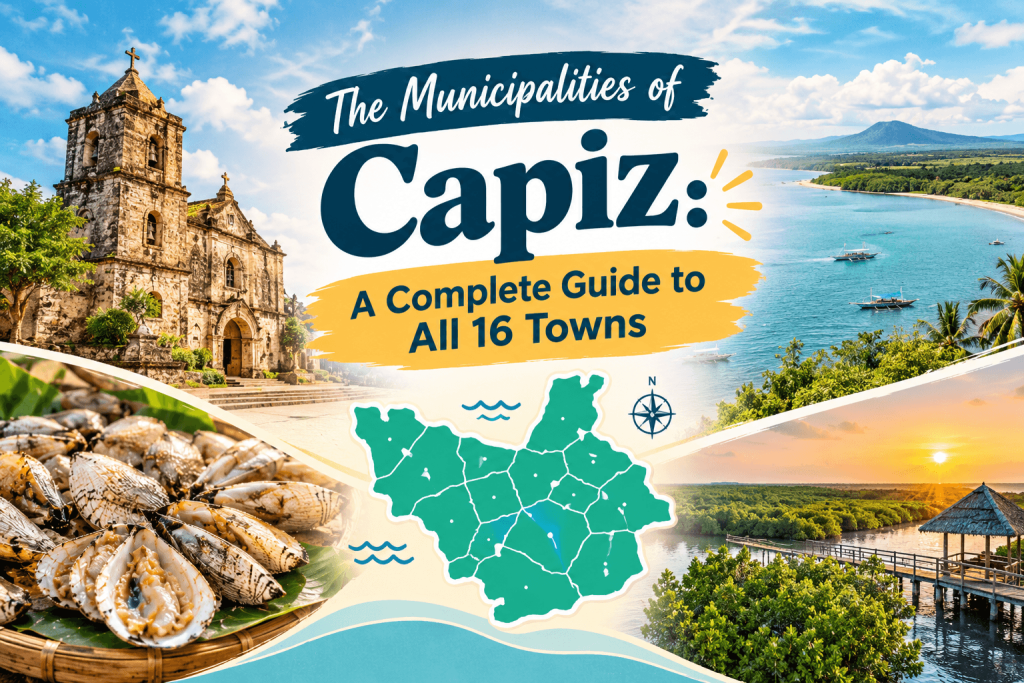
Meta description: Capiz has 16 municipalities beyond Roxas City, each with its own history, festivals, and character. Here’s a real guide to every one of them.
Most Capiz content stops at Roxas City, Panay, and maybe Baybay Beach — understandable, since that’s where most visitors go. But Capiz is a full province with 16 distinct municipalities beyond its capital city, each with its own local government, its own festival, and in several cases, genuinely distinct cultural heritage that never makes it into typical travel content. This is the complete picture.
Quick Facts
- Total local government units: 1 component city (Roxas City) and 16 municipalities
- Total barangays: 473
- Province population: approximately 835,000 (2024 census)
- Languages: Capiznon and Hiligaynon are the main local languages; Aklanon is also spoken in towns bordering Aklan province, including Sapian, Jamindan, and Mambusao
- Indigenous communities: the Panay-Bukidnon (also called Tumandok or Sulodnon), an indigenous group with their own language, embroidery tradition (panubok), and oral epic chants, live primarily in the upland areas of Tapaz and Jamindan
Roxas City (The Capital)
Already covered in depth elsewhere on this site — Roxas City is the provincial capital, the “Seafood Capital of the Philippines,” and home to Baybay Beach and the Manuel Roxas Ancestral House. See our full Travel Guide and Food Guide for everything on the city itself.
The 16 Municipalities
Panay
Home to Sta. Monica Church and the Dakong Lingganay, the largest Catholic church bell in Asia — covered in full in our dedicated article. Population: roughly 50,900.
Pilar
Known for Pilar Cave, a notable rock formation along the highway, and the Agtalin Shrine, a large hillside statue of the Blessed Mother. Pilar Bay is reputed to be the longest bay in the province and a significant fishing ground. Population: roughly 48,800.
Pontevedra
Historically recognized as an old trading center, particularly known in the 1980s for its seafood, especially crabs and shrimp. One of the province’s larger municipalities by population, at roughly 52,000.
Tapaz
The province’s most populous municipality (roughly 57,700) and a 1st-class income municipality. Tapaz is home to a small community of indigenous Panay-Bukidnon people in Barangay Tacayan, along with Marugo Lake, a popular local tourist destination. The area has been the site of active efforts to preserve the Ligbok language and the sugidanon epic chanting tradition, both considered critically endangered.
Jamindan
Also home to part of the Panay-Bukidnon indigenous community in its upland areas, alongside Tapaz. Jamindan celebrates the Pangahaw Festival each January, themed around the year’s rice harvest — the name comes from “mahaw,” meaning breakfast, tied to traditional thanksgiving performances held before the community ate the fresh harvest. Local folklore traditionally features the diwata, protector spirits of the forest. Population: roughly 40,500.
Sigma
Local tradition holds that Sigma has ties to Capiznon resistance against Spanish colonial authority, though the specific details are harder to independently verify beyond local festival retellings and oral history — worth treating as local heritage and folklore rather than settled historical record until better-documented. What’s more solidly confirmed: Sigma is home to the Sigmahanon Foundation for Culture and the Arts and celebrates the Hil-o-Hanay Festival each June. Population: roughly 32,600.
Dumarao
A 1st-class income municipality with local folklore centered on engkanto and maligno spirits, along with a documented history tied to babaylan tradition. Dumarao celebrates the Padagyaw Festival. Population: roughly 51,600, one of the province’s larger municipalities.
Dao
Home to Lolets Eco Park, a natural park with an accompanying resort. Local folklore here traditionally features duwende (dwarf spirits), and the town is also known for balut (fertilized duck egg) production as a local specialty. Population: roughly 34,600.
Dumalag
Population roughly 30,900. Documented distinguishing detail beyond general municipal life is limited in available sources — its main annual religious town fiesta runs the last week of April into the first week of May.
Mambusao
Home to the historic Mambusao Church, one of the municipality’s most recognizable landmarks. Population: roughly 41,800.
President Roxas
Named through Republic Act No. 374 in 1949, honoring Manuel A. Roxas. Population: roughly 32,400.
Ivisan
Home to white sand beaches in Barangays Basiao and Balaring, offering a quieter alternative to Baybay Beach for visitors willing to venture slightly further from Roxas City. Population: roughly 32,900.
Sapian
Known for Gugma Beach, along with wide, Class A fishponds used for cultivating milkfish (bangus) and other farmed fish species — a significant part of the municipality’s local economy. Like Jamindan and Mambusao, it sits close enough to the Aklan border that Aklanon is commonly spoken alongside Capiznon and Hiligaynon. Population: roughly 27,400.
Cuartero, Panitan, and Ma-Ayon
These three municipalities round out the province’s remaining local government units, each with populations ranging from roughly 27,000 to 45,000. Specific standout attractions for these towns are less documented in available sources compared to the municipalities above — if you have direct knowledge of a landmark, festival, or product worth featuring in any of these towns, we’d genuinely like to hear about it and update this guide accordingly.
A Province-Wide Cultural Thread Worth Knowing
Beyond individual town facts, one thing ties several of these municipalities together: the Panay-Bukidnon (Tumandok) indigenous community, concentrated in the upland areas of Tapaz and Jamindan specifically, though the broader ethnolinguistic group extends into neighboring Iloilo and Antique provinces as well. They maintain their own oral epic chanting tradition (sugidanon), a distinctive embroidery style (panubok), and their own indigenous language, portions of which — like Tapaz’s Ligbok language — are actively endangered and subject to ongoing preservation efforts. This is a genuine, living cultural heritage layer to Capiz that most tourism content built purely around Roxas City and the coast never touches.
Frequently Asked Questions
Capiz has 16 municipalities plus 1 component city (Roxas City), for a total of 473 barangays across the province.
Tapaz is the most populous municipality, with a population of roughly 57,700 as of the 2024 census.
Tapaz and Jamindan are home to communities of the Panay-Bukidnon (also called Tumandok or Sulodnon) indigenous people, known for their oral epic chanting tradition and distinctive embroidery.
Aklanon, the language of neighboring Aklan province, is commonly spoken alongside Capiznon and Hiligaynon in the border municipalities of Sapian, Jamindan, and Mambusao.
Related reading: Capiz Province, Philippines: Complete Travel Guide | Sta. Monica Church and the Dakong Lingganay

As a versatile digital strategist, the author brings a wealth of technical and creative expertise to the table. He is a “Certified Content Marketing Specialist” with several years of experience navigating the complexities of “digital marketing” and “SEO” to drive meaningful engagement. Beyond the screen of analytics, he is deeply passionate about the intersection of form and function, maintaining an active practice in both **web design** and **web development** to build seamless, high-performing digital experiences.