Last updated: 2026 — festival details, dates, and program specifics can change year to year, so treat the historical/background sections as stable and the specific 2026 program details as a snapshot of that year rather than a permanent lineup.
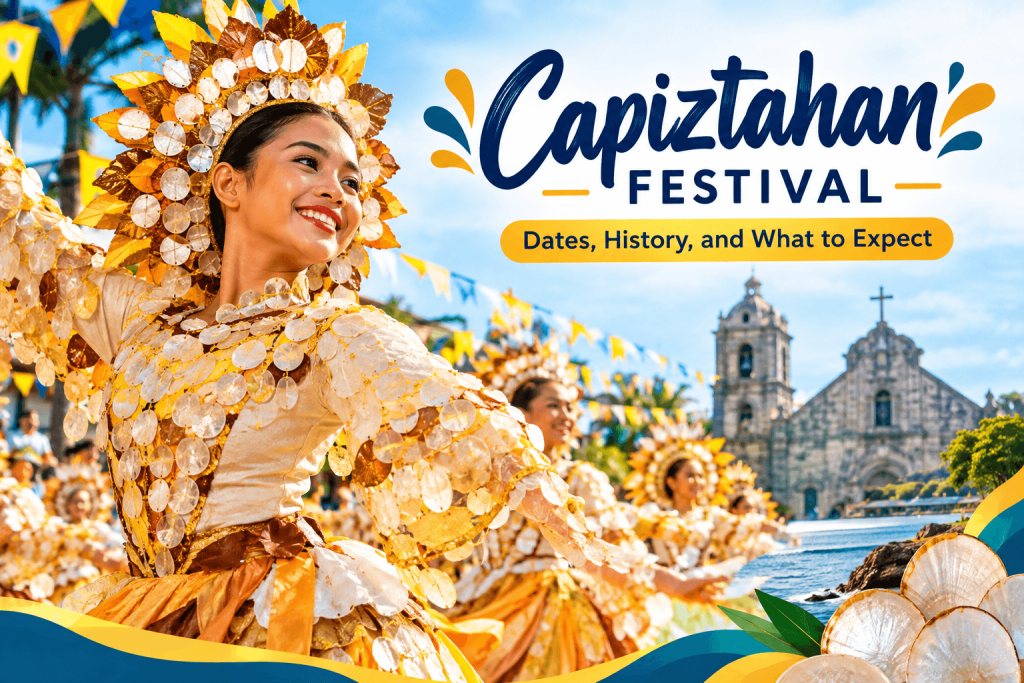
If you’re planning a Capiz trip around one event, this is it. Capiztahan is the province’s longest-running and most significant annual celebration — and unlike a lot of provincial festivals that stay purely local, it’s recently earned genuine national recognition.
Quick Facts
- What it commemorates: the founding of Capiz’s civil government (established April 15, 1901) and the death anniversary of former Philippine president Manuel A. Roxas
- Typical dates: mid-April, generally running April 13–19
- 2026 milestone: marked the “quasquicentennial” — 125 years since the province’s civil government was established
- Recognition: named Grand Winner for Best Cultural Festival (Provincial Category) at the 2025 Pearl Awards, jointly conferred by the Association of Tourism Officers of the Philippines and the Department of Tourism
- Main venue: the Capiz Provincial Capitol Grounds at Pueblo de Panay, Roxas City
What Capiztahan Actually Celebrates
Capiztahan marks two things at once: the anniversary of Capiz becoming a formally established civil province under American colonial administration in 1901, and a memorial for Manuel A. Roxas — the province’s most famous son and the first president of the Philippine Third Republic, for whom Roxas City itself is named.
The name itself is a portmanteau: “Capiztahan” combines “Capiz” with “kapistahan” (or the Spanish-derived “pista”), the general Filipino word for festival or fiesta — not a reference to the same “kapid” (twins) folklore story tied to the province’s own name.
The History and Evolution of Capiztahan
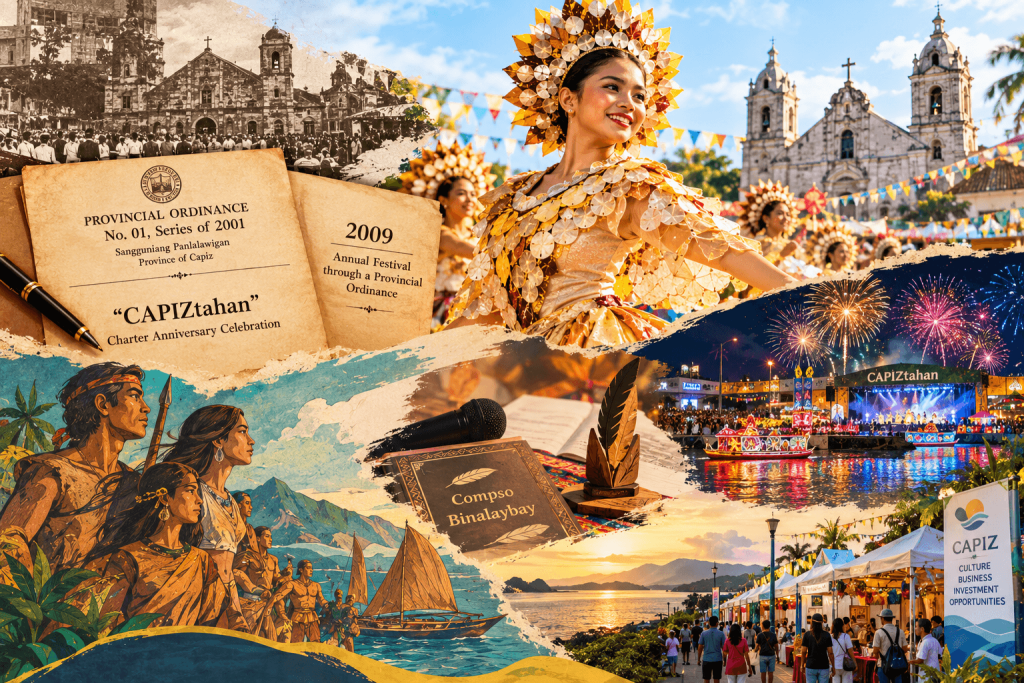
The founding-anniversary celebration existed informally for decades before it had the name it carries today. The provincial government formally named it “CAPIZtahan” through Sangguniang Panlalawigan (Provincial Board) Ordinance No. 01, Series of 2001, officially designating the celebration of Capiz’s Charter Anniversary every April 15 under that title. What had been a more modest civic commemoration was then further institutionalized as a recurring annual event through a follow-up provincial ordinance passed in 2009.
From there, the festival grew in scale year over year — early 2010s editions added elements like international dance workshop exchanges, fireworks competitions (branded in some years as “Clash of Champions”), expanded trade fairs, and investor forums alongside the cultural programming. By its 2009 edition, marking the province’s 108th founding anniversary, Capiztahan already included composo (folk song) and binalaybay (poetry) competitions specifically built around telling Capiz’s own history and culture back to its own people — a pattern that’s continued and expanded in more recent years through elements like the Maragtas sang Capisnon Cultural Performances and, in the 2026 edition’s planning, a large-scale projection-mapping presentation called Sine Maragtas, designed to bring the province’s history to life visually.
Some tellings of the festival’s cultural backdrop also reach further back than 1901, into the Maragtas — a compiled account of Panay Island’s oral traditions and legendary pre-colonial history, describing early Atis inhabitants and the later arrival of Malay settlers under legendary chieftains. It’s worth being clear-eyed about this layer specifically: the Maragtas is treated by modern historians as a blend of genuine oral tradition and later literary embellishment, not a verified historical record in the way the 1901 provincial founding date is. Capiztahan draws on it as cultural heritage and storytelling, not as settled historical fact, and that distinction is worth keeping in mind if you encounter it presented more absolutely elsewhere.
What Happens During the Festival
Based on the actual 2026 program, here’s what a typical Capiztahan lineup includes:
- Maragtas sang Capisnon Historical Parade/Cultural Performances — the festival’s core cultural showcase, featuring performances from all 16 municipalities and Roxas City, tied to Panay’s Maragtas historical/legendary tradition
- Surambaw Seafood Festival — a dedicated event reinforcing Capiz’s identity as the country’s seafood capital, timed within the festival week
- Maragtas Street Market and nightly street parties — the main gathering points for food, vendors, and evening entertainment
- Capiztahan Battle of the Bands — a music competition held across multiple venues
- Capiztahan Grand Job Fair — a province-wide employment event held alongside the festivities
- Capiztarun Half Marathon and Panay Ride — sports and endurance events, typically toward the festival’s final days
- Pyromusical Show — a synchronized fireworks display, usually one of the visual highlights of the week
A Note on the 2026 Edition Specifically
Worth knowing if you’re comparing notes with older articles or photos: the 2026 Capiztahan ran on a scaled-down budget due to rising global fuel costs, with the provincial government cutting roughly PHP 10 million from an initial PHP 54 million budget. The float parade competition specifically was scrapped that year as a cost-saving measure, with cultural performances taking center stage instead. The 2026 edition also marked the first use of the newly completed Capiz Provincial Capitol as the event’s central venue, and included a cultural exchange with the provinces of Aklan and Romblon — both of which were historically part of Capiz before becoming separate provinces.
The takeaway: the exact program can shift meaningfully year to year based on budget and local conditions. Check the Provincial Tourism and Cultural Affairs Office’s current announcements before finalizing plans around a specific event within the festival.
Should You Plan a Trip Around It?
Yes, if you want to see Capiz at its most alive. Roxas City transforms during festival week — street parties, provincial-wide cultural performances, and a genuine sense of province-wide participation you won’t get visiting on a normal week. Just book accommodations well ahead of time, since this is the province’s highest-traffic week of the year, and expect some road closures and crowding around the Provincial Capitol Grounds during main events.
Frequently Asked Questions
The name combines “Capiz” with “kapistahan,” the Filipino word for festival or fiesta. It’s unrelated to the separate “kapid” (twins) folklore story sometimes told about the origin of the province’s own name.
While Capiz’s founding-anniversary celebrations existed informally earlier, the provincial government formally named and established the modern “CAPIZtahan” celebration through a provincial ordinance in 2001, with further institutionalization following in 2009.
Capiztahan is typically held in mid-April, generally running from April 13 to 19, though exact dates can shift slightly year to year.
Capiztahan commemorates the founding of Capiz’s civil government in 1901 and honors former Philippine president Manuel A. Roxas, the province’s most famous son.
Yes. Capiztahan is Capiz’s longest-running and largest annual festival, recently recognized as Grand Winner for Best Cultural Festival (Provincial Category) at the national Pearl Awards, while Sinadya sa Halaran runs on a smaller scale.
The main venue is the Capiz Provincial Capitol Grounds at Pueblo de Panay in Roxas City, with additional events held at various venues across the city and province.
Related reading: Capiz Province, Philippines: Complete Travel Guide | Capiz Food Guide: What to Eat in the Seafood Capital
As a versatile digital strategist, the author brings a wealth of technical and creative expertise to the table. He is a “Certified Content Marketing Specialist” with several years of experience navigating the complexities of “digital marketing” and “SEO” to drive meaningful engagement. Beyond the screen of analytics, he is deeply passionate about the intersection of form and function, maintaining an active practice in both **web design** and **web development** to build seamless, high-performing digital experiences.