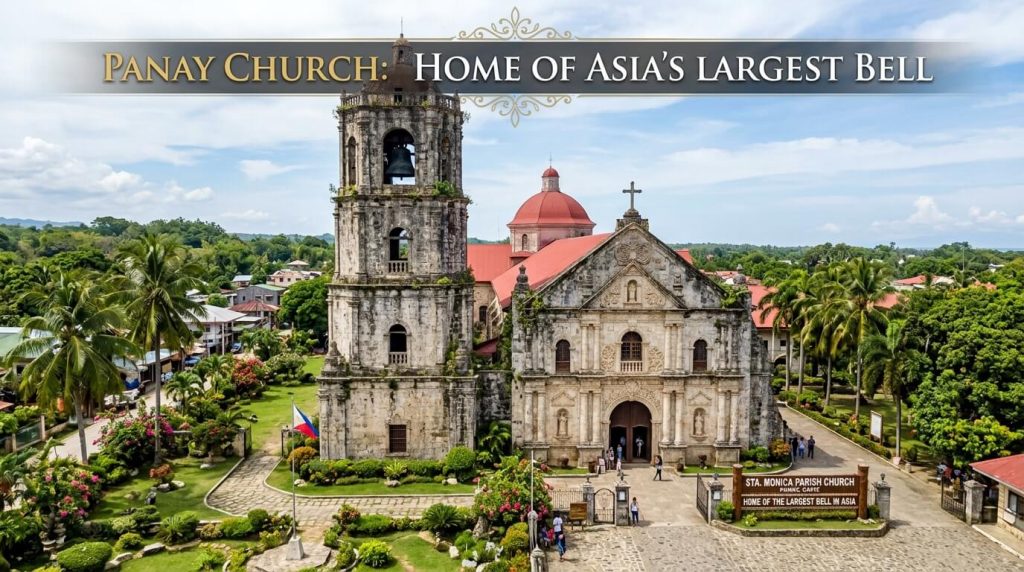
Sta. Monica Church and the Dakong Lingganay: Asia’s Largest Church Bell
Most people who make the trip to Panay town come for one thing: to stand under a 10.4-ton bell and understand, in person, why “big” undersells it. But the Dakong Lingganay is only part of the story. The church holding it has survived typhoons, reconstruction, and centuries of Philippine history, and it’s one of the few places in the country where you can physically climb into a piece of that history rather than just read about it behind glass.
Quick Facts
- Full name: Santa Monica Parish Church, commonly called Panay Church
- Location: Iloilo East Coast–Capiz Road, Panay, Capiz — about 15 to 20 minutes’ drive from Roxas City
- Denomination: Roman Catholic, dedicated to Saint Monica
- Architectural style: Filipino Colonial Neo-Classical Baroque
- Heritage status: National Historical Landmark (1997), National Cultural Treasure (2004)
- Dimensions: roughly 70 meters long, 25 meters wide, 18 meters high, with walls about 3 meters thick
- The bell: the Dakong Lingganay (“Big Bell”), reportedly cast around 1878, weighing approximately 10,400 kilograms (10.4 metric tons), audible up to 8 kilometers away
A History Reconstructed More Than Once
Exactly how old this parish is depends on which layer of its history you’re counting. Augustinian friars were active in the Panay region from the earliest years of Spanish colonization in the 16th century, and some sources trace the founding of the parish itself to the late 1600s. What’s more consistently documented is the physical structure: an earlier church building, constructed around 1774, was gravely damaged by a massive typhoon on January 17, 1875. The church seen today — the one with the coral-stone walls and the bell tower — was reconstructed and completed in 1884.
That reconstruction is what earned Panay Church its heritage status: it was declared a National Historical Landmark by the National Historical Commission of the Philippines in 1997, and elevated to National Cultural Treasure status in 2004.
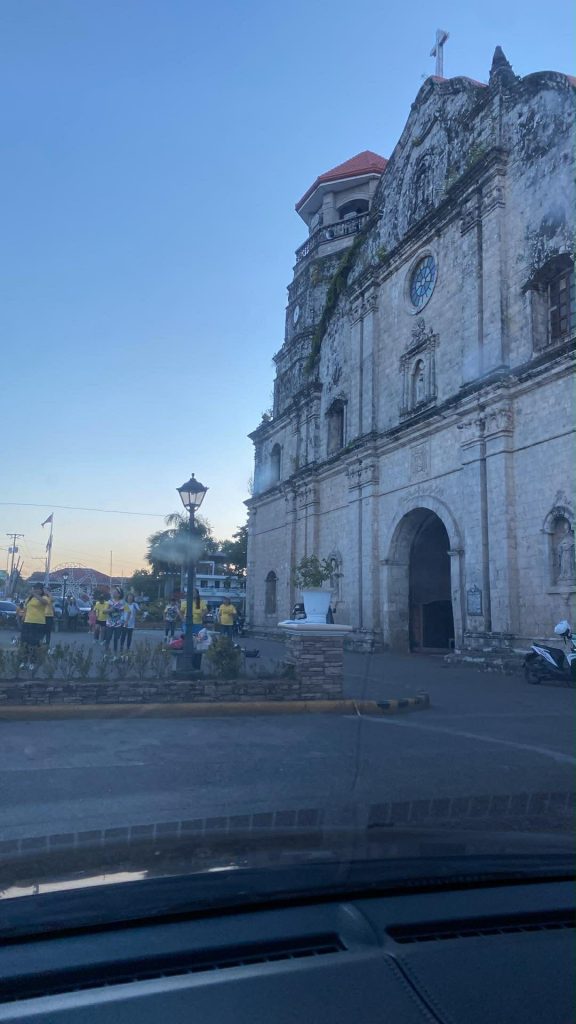
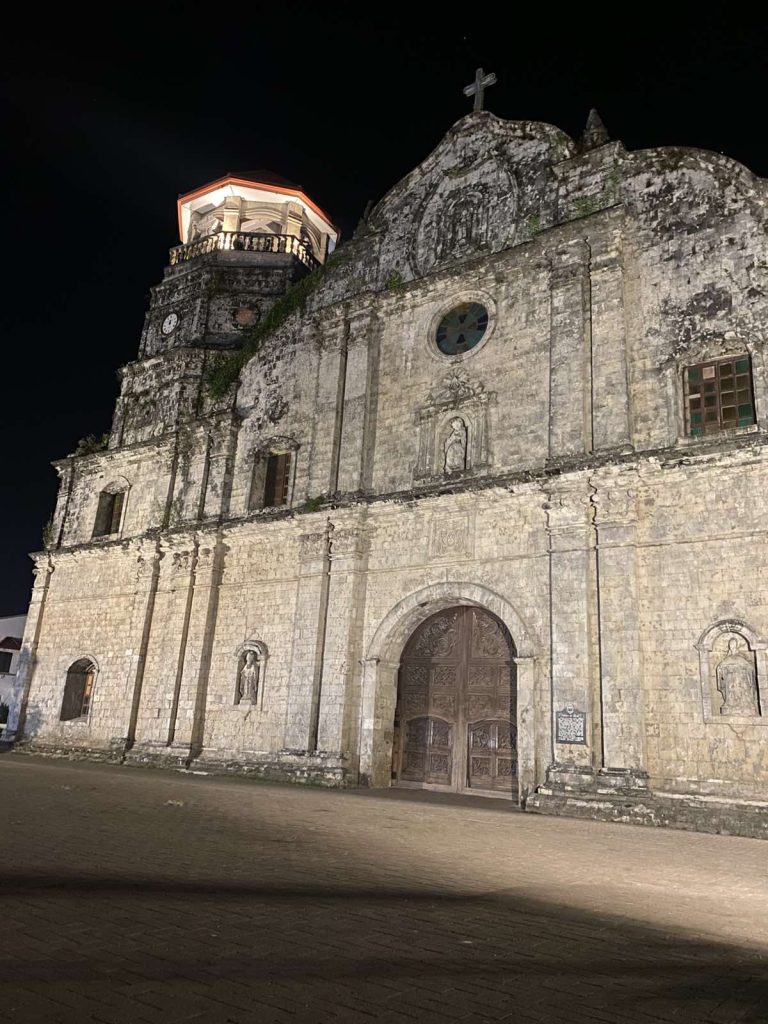
Santa Monica Church during the day and night. The belfry houses the biggest ball in Asia. Original pictures by the author.
The Bell Itself
The Dakong Lingganay wasn’t cast from ordinary bell metal alone — local parishioners are said to have donated gold and silver coins, collected over decades, which were melted down and cast into the bell. It stands about 5 feet tall and measures 7 feet in diameter, and its sheer mass — roughly 10.4 metric tons — is what makes it, by most accounts, the largest Catholic church bell in Asia.
The bell carries a Spanish-language inscription, still legible today:
“Soy la voz de Dios que llevare y ensalzare desde el principio hasta el fin de este pueblo de Panay para que los fieles de JesuCristo vengan a esta casa de Dios a recebir las gracias celestiales.”
Roughly translated: “I am God’s voice, which I shall carry and exalt from one end of this town of Panay to the other, so that the faithful followers of Jesus Christ may come to this house of God to receive heavenly graces.”
It hangs in a multi-story belfry alongside several smaller bells, and its sound has historically carried across roughly an 8-kilometer radius — in an era before amplified sound, that made it a genuine communication tool for the town, not just a religious instrument.
Inside the Church
Beyond the bell, the church itself is worth slowing down for. The Latin cross floor plan centers on a large main altar flanked by four lateral altars, each fitted with gilded hardwood retablos (altar screens) and painted statues. The coral-stone walls, roughly three meters thick, keep the interior notably cooler than the outside heat — a practical detail worth appreciating once you’re standing in Capiz’s midday sun. On the grounds, look for the Fuente de Vida, the old parish well, and the Museo de Santa Monica, housed in what used to be the church’s convent, which now displays religious relics and artifacts from the parish’s history.
Visiting the Bell Tower
Climbing up to see the bell up close is possible, but it comes with real conditions:
- You need permission from the parish office first. This isn’t a self-guided climb — check in before heading up.
- Expect roughly 63 steps, on a stairway that’s been renovated with handrails but is still steep and narrow in places. Visitors with weak knees or claustrophobia should think carefully before attempting it.
- Bring water and sun protection. Multiple visitors note the heat can be intense, especially with limited airflow inside the tower.
- A tip for your guide is customary if one accompanies you up, which is common practice at the site.
- The reward at the top is a panoramic view of Panay town in addition to standing beside the bell itself.
Getting There
From Roxas City: roughly 15 to 20 minutes by tricycle or private vehicle, depending on traffic and exact route.
From Iloilo City: head to the Iloilo North Bus Terminal in Jaro and take a Ceres bus bound for Roxas City; the trip takes approximately 3 to 4 hours, with Panay reachable along the way or via a short transfer once you’re closer to Roxas City. Confirm current bus schedules before relying on this route, since operators and timing shift over the years.
Frequently Asked Questions
The Dakong Lingganay, housed in the belfry of Sta. Monica Church in Panay, Capiz, is widely recognized as the largest Catholic church bell in Asia, weighing approximately 10.4 metric tons.
The parish traces back to the early Spanish colonial period, but the current church structure was completed in 1884, replacing an earlier building from around 1774 that was destroyed by a typhoon in 1875.
Yes, with permission from the parish office beforehand. The climb involves roughly 63 steps on a steep but renovated stairway, and isn’t recommended for visitors with weak knees or claustrophobia.
It’s about a 15 to 20 minute tricycle or car ride from central Roxas City.
Related reading: Capiz Province, Philippines: Complete Travel Guide | Baybay Beach, Roxas City: The Complete Guide

As a versatile digital strategist, the author brings a wealth of technical and creative expertise to the table. He is a “Certified Content Marketing Specialist” with several years of experience navigating the complexities of “digital marketing” and “SEO” to drive meaningful engagement. Beyond the screen of analytics, he is deeply passionate about the intersection of form and function, maintaining an active practice in both **web design** and **web development** to build seamless, high-performing digital experiences.